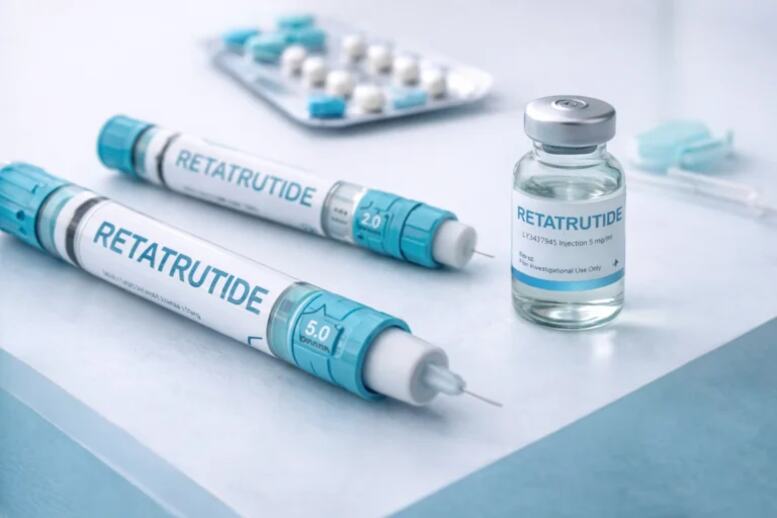
Peptide science has moved quickly over the last decade, and few compounds have drawn as much discussion in laboratory circles as retatrutide. For researchers working in metabolic science, it represents a genuinely different design from the peptides that came before it. Here is a plain look at what it is, why it is studied, and what matters when sourcing it for laboratory work.
A different mechanism
Most people who follow peptide research are familiar with single receptor
compounds. Semaglutide, for example, acts on the GLP-1 receptor. Tirzepatide went
a step further as a dual agonist, engaging both the GIP and GLP-1 receptors.
Retatrutide is a synthetic peptide designed as a triple agonist. It targets three
receptors at once: GLP-1, GIP, and glucagon. That third pathway is what separates
it from everything before it, and it is the reason the compound has become such a
frequent subject in metabolic research literature. The scientific interest is in
the mechanism itself, how three receptor pathways interact, rather than in any
single outcome.
Still investigational
It is worth being clear about status. Retatrutide is an investigational compound.
It is not an approved medicine, and material sold for laboratory use is supplied
strictly for research use only. It is not for human or veterinary consumption. Any
serious supplier will state this plainly, and any laboratory sourcing it should
treat it accordingly.
What actually matters when sourcing
For a research setting, the compound itself is only half the equation. The
condition of the material determines whether results mean anything.
Purity is the first checkpoint. Analytical grade material is normally verified by
HPLC, and the figure most laboratories look for is 99% or above. Below that,
impurities start to introduce variables that a study cannot control for.
Presentation matters too. Research peptides are normally supplied as a lyophilized
powder in a sealed vial. In that dry state the material is stable and
straightforward to ship, which is one reason powder is the standard format rather
than a ready made solution.
Storage is simple but not optional. Keep vials cold and away from light, and
reconstitute only what is needed, using bacteriostatic water, at the point of use.
Once in solution the clock starts, so most laboratories prepare small amounts
rather than everything at once.
Batch consistency is the quiet third factor. A laboratory comparing results across
weeks needs to know that the second vial behaves like the first, which is why
staying with one supplier, and one batch where possible, saves a lot of confusion
later.
Sourcing in Europe
European researchers have more options than they did a few years ago. Suppliers now
list research grade retatrutide with published purity figures and ship within the
EU, which removes the customs delays and temperature exposure that used to
complicate overseas orders.
Availability is often organised by country. A laboratory in France, for instance,
would generally source retatrutide through a supplier with local shipping rather
than importing from outside the region.
The takeaway
Retatrutide is interesting because of its design, not because of any promise
attached to it. It is a triple agonist in a field that had only reached dual
agonists, and that alone makes it a compound worth understanding. For anyone
sourcing it for laboratory work, the questions that matter are unglamorous and
practical: what is the purity, what condition did it arrive in, how is it stored,
and does the next vial match the last. Get those right and the research stands on
solid ground.
Mehr Lesen: anne wünsche fapello